 Guadeloupe .net
Constant Sorin
A military officer and civil administrator, he was Governor of Guadeloupe from 1940 to 1943. A controversial figure viewed in various ways because of his participation in administering Vichy's power, he remains associated, for the island's population, with the memory of a period of food shortages.
From the Breton and Vendée petty bourgeoisie, he studied at the lycée in Morlaix, then, after a law degree, prepared for the École Navale. A severe cerebral fever made him give up his initial plan, and he was eventually admitted to the École Spéciale Militaire de Saint-Cyr at the age of 21. He was an instructor at that same institution in 1923 and 1924, then from 1929 to 1931. From 1924 to 1928, he served in the Saharan Méhariste Formations, before obtaining his staff officer certificate from the École Supérieure de Guerre in 1934.
Attracted by overseas service, he successfully sat the competitive examination for the Colonial Inspection in 1936 and resigned from the army. Various financial control and administrative missions were entrusted to him in French West Africa and French Equatorial Africa in 1937 and 1938; it was at this time that he received the distinction of Chevalier de la Légion d'Honneur.
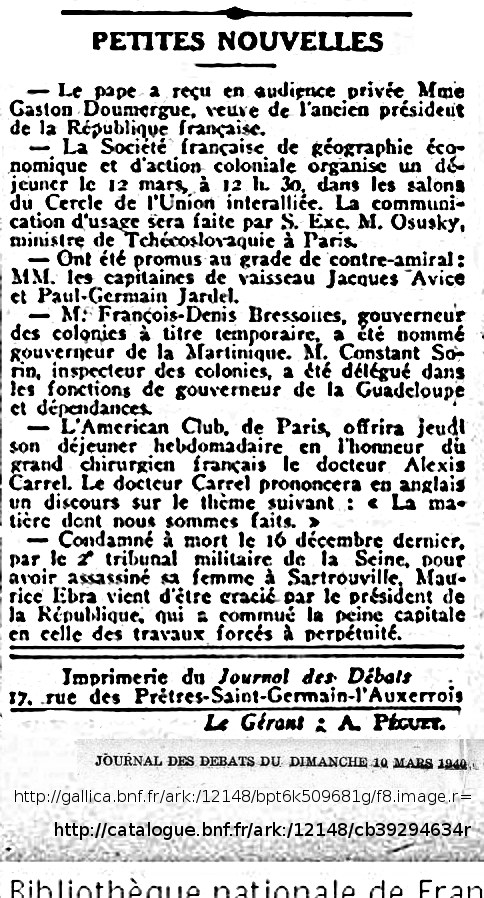
At the 1939 mobilization, he was assigned to the Economic Affairs department of the Ministry of the Colonies as deputy director, before being appointed Governor of Guadeloupe by Georges Mandel (then Minister of the Colonies) in 1940, a post he held until July 1943.
During his administration of the island, he launched a policy remembered as "l'Effort Guadeloupéen", based on pursuing self-sufficiency. Several decrees were issued to support this program, among which one may cite the ban on felling fruit trees. He sought to convince landowners of the need for food crops and to push them toward developing local production. In practice, the material results were rather mediocre and Sorin's policy was little followed by the large producers, who were more inclined to speculation. It did not suffice to offset the effect of the total blockade of 1943, nor the lack of imported products. The demographic curves of the period attest to the suffering experienced by Guadeloupeans.
The Gaullists having taken possession of the Antilles, he was repatriated to mainland France in November 1943. At the Liberation he returned to his military career and took part in the Alsace and Germany campaign under General Valluy. Assigned to General Leclerc's staff in July 1945, he landed in Indochina and stayed there until April 1948. Demobilized, he then devoted himself exclusively to the food industry, worked for a few months at the Comité Interprofessionnel du Rhum, before leaving for Madagascar as a delegate of the Groupement d'Achat des Produits Oléagineux.
Definitively back in France in 1952, he became a technical adviser at the Bureau d'Études pour la Production Agricole in the T.O.M., then president of the Syndicat Général des Producteurs de Sucre des Antilles Françaises.
He died at the hospital in Neuilly on January 20, 1970.