 Guadeloupe .net
Creole Guadeloupe
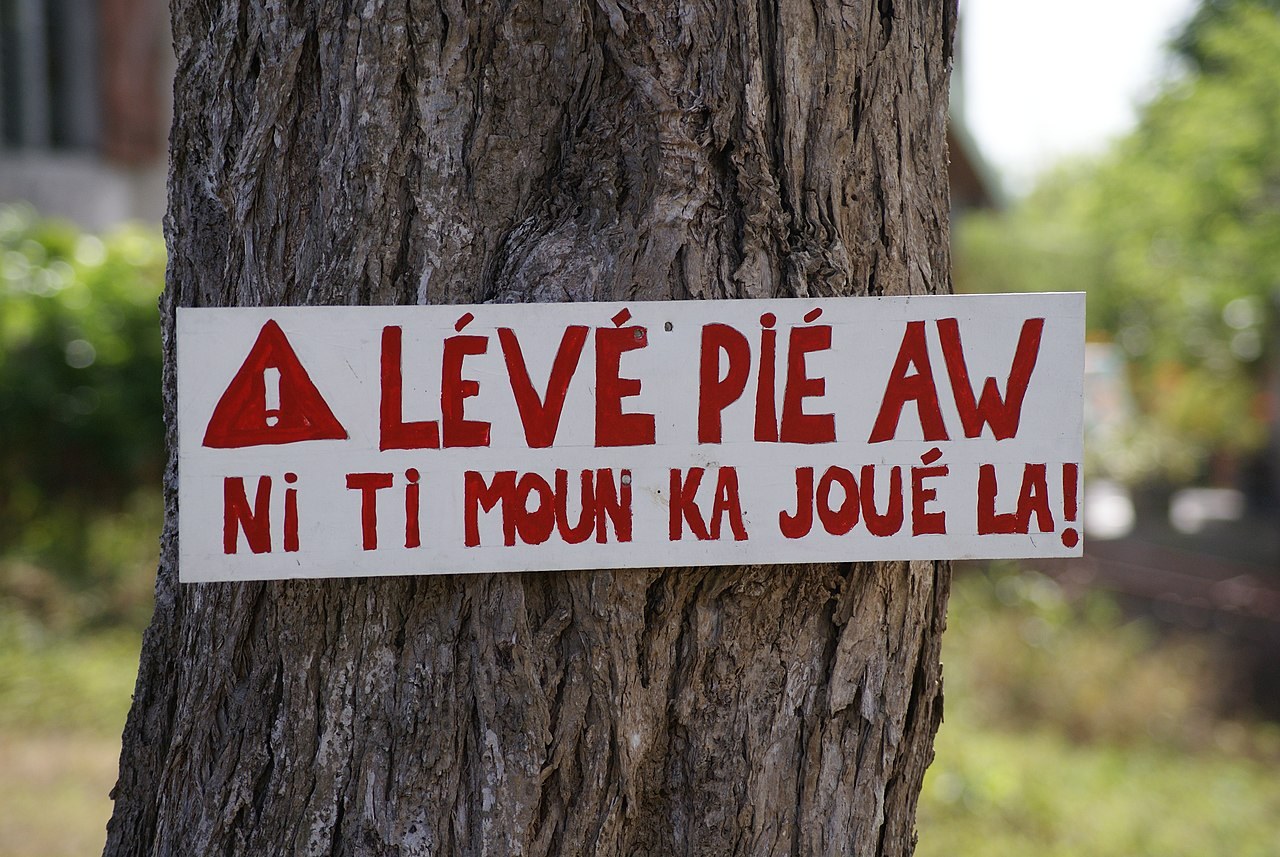
Several Creole languages exist, and Guadeloupe has its own. Of course, French remains the base of Guadeloupean Creole, yet a person from mainland France will have a hard time understanding it. Other languages have also influenced it, due to the history and successive colonizations of Guadeloupe. Thus English, Portuguese, and Dutch sounds are found in it. Creole was born in the 17th and 18th centuries, during the slavery period.
Guyanese, Haitian, Martinican, Saintes, and Guadeloupean Creoles show strong similarities; it is even common to speak of a single language, Antillean Creole, to designate them. Thus, the inhabitants of these islands can communicate perfectly and understand one another even though they are not neighbors.
Creole is the dominant language in the Antilles, and the same is true in Guadeloupe. 850,000 people speak Guadeloupean Creole, including 350,000 in Guadeloupe. It is an important cultural feature of the island.
Creole is above all a spoken, oral language, because its syntax remains complex. This point also has a historical origin; indeed, slaves could neither read nor write. It was G.E.R.E.C (Groupe d'Études et de Recherches en Espace Créolophone) that established the rules and standards for writing Creole. This working group has been studying the culture and language of several Creole populations (Guadeloupe, French Guiana, Martinique, etc.) since 1975.
As for the alphabet, Guadeloupean Creole consists of 10 vowels (3 nasal vowels and 7 oral vowels) and 19 consonants. It is essentially based on a modification of the pronunciation of French words; the creolization of words is still common today for more recent words.
As for grammar, the formal "vous" form is absent, plurals and genders do not exist, possessive and personal pronouns are merged, and in this case the noun is placed before the pronoun to emphasize possession. There are two different verbs for the verb to be.
As for conjugation, 5 predicatives are used before the verb to specify tense, a point comparable with English conjugation.
It is entirely possible to learn Creole thanks to existing books.
More than a language, Creole is a way of life, evoking history, slavery, music, celebration, and dance. It is a singing language.
Here are a few Creole expressions:
- A dèmen: See you tomorrow
- An ka chèché: I am looking for
- An pa sav palé Kréyòl: I don't know how to speak Creole
- An té ké vlé: I would like
- Annou ay !: Let's go
- Ba mwen…: Give me…
- Sa cho: It's very hot!
- Bay on bo: Give a kiss
- Bonjou: Hello
- Bonswa: Good evening
- Doudou: Darling
- Eskizé mwen: Excuse me
- Fout i bon menm !: It's really delicious!
- Gidé mwen: Guide me
- I pa bon / sa pa bon: It's bad
- Ka ki là ?: Who is there?
- Ka sa yé ?: What is it?
- Kikoté ?: Which side?
- Ki jan aw ?: What are you doing?
- Ki laj ou ka fè ?: How old are you?
- Mésyé zé dam bonjou !: Hello ladies and gentlemen!
- Mwen enmé-w doudou: Darling, I love you
- ovwa !: Goodbye
- Pani pwoblèm/ sa pa ayen: You're welcome
- Sa kay/ an la/ an byen: I'm fine
- Sa ou fé ?: How are you?
- Sa pa chè: It's not expensive
- Sèk-sèk: A small glass of neat rum
- Si ou plé: Please
- Tanzantan: Sometimes, from time to time
- Ti-bo: A kiss
- Vini: Come