 Guadeloupe .net
Joseph Bologne de Saint-George
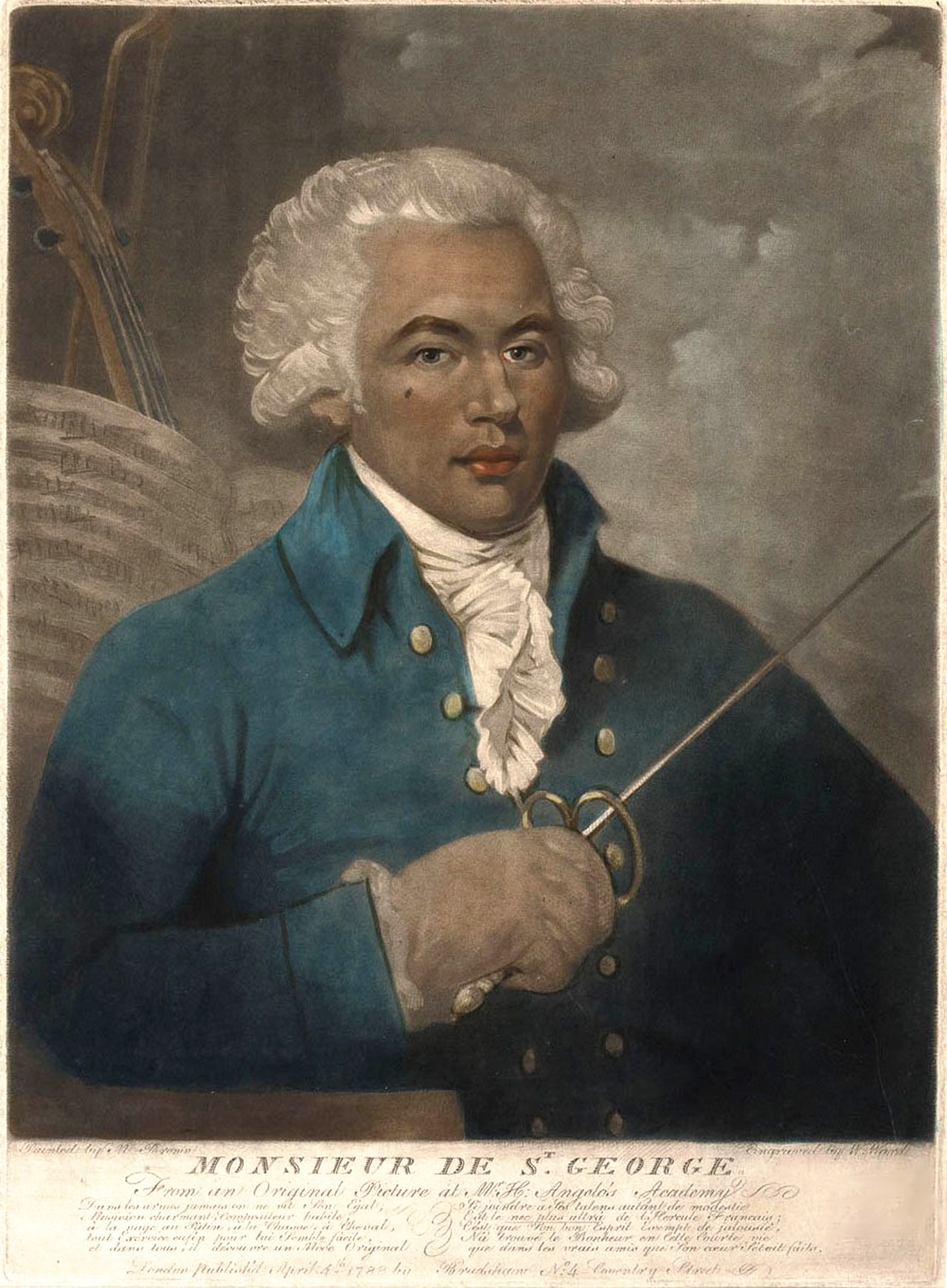
Joseph Bologne de Saint-George, better known by his pseudonym "Chevalier de Saint-George", was born on December 25, 1745 in Guadeloupe and died on June 12, 1799 in Paris. Born to an enslaved mother and a white colonist believed to be Georges de Bologne Saint-George, despite some controversy linked to the absence of written records. His extraordinary career, his commitment to the civic values of the French Revolution, as well as his many talents as a fencer, soldier, violinist, composer and conductor, made him an emblematic and almost legendary figure of emancipation and of the abolitionist circles of the Enlightenment.
Brought to France at a very young age and protected by his paternal family, he received an aristocratic education there and led the life of a freedman and a free man. At the age of 13, he was enrolled as a boarder with Nicolas Texier de la Boëssière, a man of letters and a politician, who would become his spiritual father as well as his fencing master. He prepared him for the profession of officer and made him one of the most exceptional fencers of his time. Chronicles and engravings have left us many accounts of his feats, such as the famous assault against the Chevalière d'Éon.
Although perfectly integrated into Parisian society, he was not immune to the racial prejudices linked to his condition as a mixed-race man, even as colonial subjects and slavery were at the heart of 18th-century debates. It was very certainly under the influence of his cultural and political environment that he made the choice of his initiation into a Masonic lodge, as an adult.
In 1761 he was admitted to the Musketeers, a corps of the Gendarmes of the King's Guard. On May 10, 1763, Georges de Bologne bought him a charge of "Conseiller du Roy", which entitled him to the title of Écuyer and later authorized him to bear that of Chevalier.
With advanced musical training, in 1769 he took the position of first violin in the orchestra of the "Concert d'Amateurs", under the direction of François Joseph Grossec, whom he later replaced as conductor, until March 1779. He was then successively entrusted with the direction of the "Concert Spirituel" and that of the "Société Olympique", a foundation of the Grand Orient de France. A man of the court, he was admitted to the Palais Royal in the service of the Orléans family. Some authors even attribute to him the role of Music Master to Queen Marie Antoinette.
A contemporary of Mozart and an atypical musician, he left sonatas, symphonies and concertos, and tried his hand at theatrical writing and opera.
At the beginning of the French Revolution he stayed in England, before enlisting in the National Guard as a Captain. The monarchy having been abolished on September 21, 1792, he created and took command as colonel of "La Légion Franche des Américains du Midi", 13th regiment of horse chasseurs, partly composed of descendants of Africans. Under his orders was Alexandre Dumas père, future General of the Revolution. During the Terror, in the course of an episode known as "the Dumouriez affair", he was suspected of royalist sympathies, arrested and then released after a year of detention, narrowly escaping the scaffold. He was dismissed from his duties on October 5, 1795, the victim of a law aimed at purging the army of its royalist officers. Deprived of his income by political events, he returned to civilian life and died four years later in destitution. His death was nonetheless honored, and his merits were saluted by the press of the time.
His biographers are numerous, his name and his exploits appear in several works by Balzac, but Roger de Beauvoir may be considered the inventor of the "Saint-Georgian saga" in the 19th century, with "Le Chevalier de Saint-Georges" in 4 volumes, published in 1840.
Many cultural tributes are regularly paid to him, both within the musical community and among that of e