 Guadeloupe .net
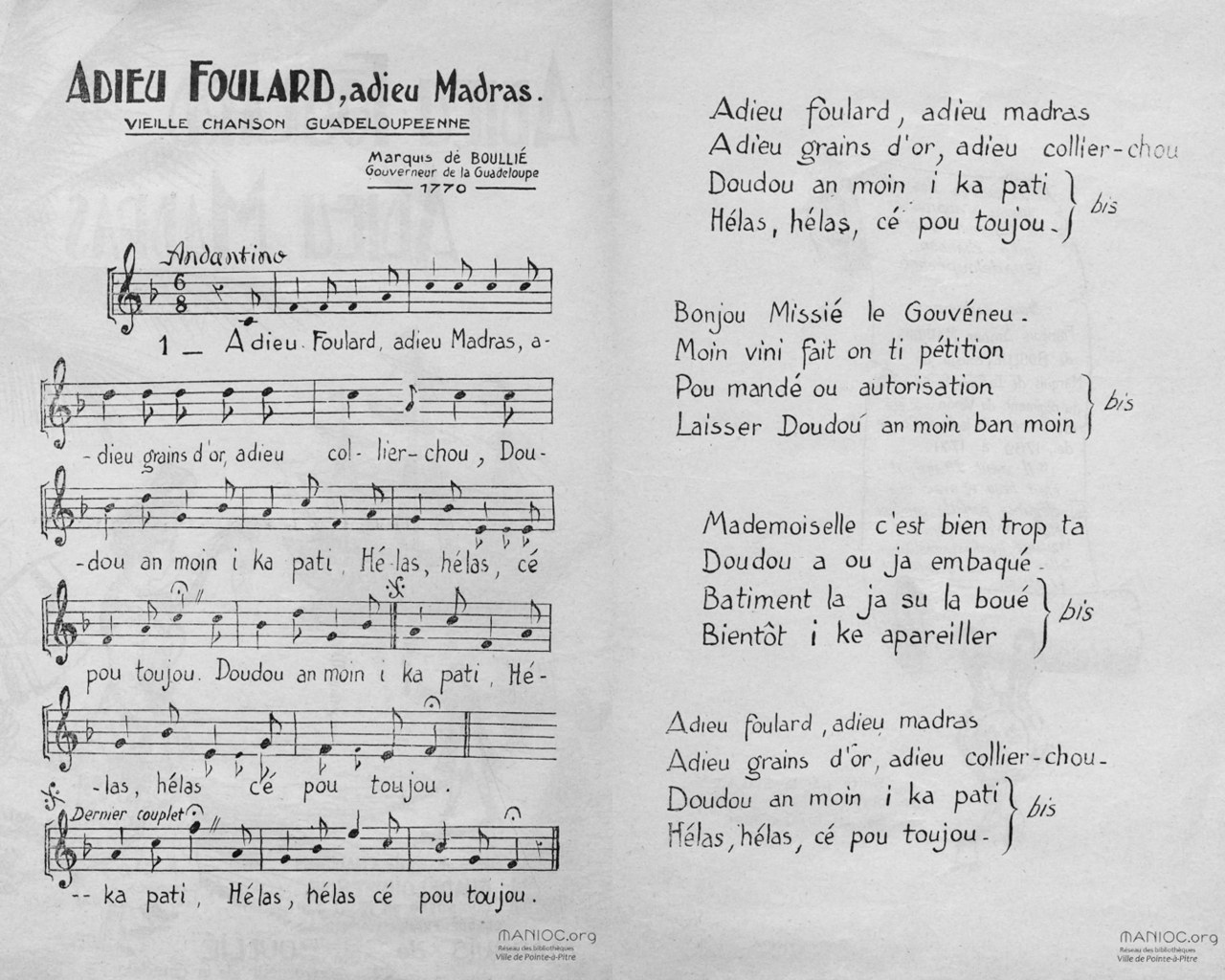
Madras Guadeloupe
Note that the checkered fabric originally made specifically for cutting squares of cloth intended for blowing one's nose was used for other purposes. The large dimensions given to it made it particularly difficult to tell a handkerchief from a scarf. So a square of fabric used as a headdress, shawl, necktie, belt, bundle, etc., was called a handkerchief.
Madras fabric was imported to Guadeloupe by Indians who, along with many Annamites, came after the abolition of slavery to replace the free labor force.
This fabric with distant origins has become the symbol of the Antilles since elegant women chose it for their clothing.
The traditional everyday Guadeloupean dress is white, adorned with lace and embroidery made and arranged according to several models: empire, bourgeoise, maman-poule, princesse… It is brightened by a madras scarf around the hips and one on the head.
The festive-day dress is a long dress whose train is turned up and fastened at the side to the waist. In this way it lets an embroidered underskirt edged with lace be admired. Even if it can be in printed fabric, sometimes even silk, it is most often in madras.
Either of these outfits is completed by a headdress made from a knotted square of madras, typical of Guadeloupe and recognized worldwide: the “têt”. They are nicknamed: chaudière, cocotte or casserole depending on their shape, which makes it possible to recognize the island the woman wearing it comes from and the gallant message she wants to convey: if one point sticks out (têt un bout), her heart is available; if two points stick out (têt deux bouts), she is engaged; and if three points stick out (têt trois bouts), she is married. As for the “têt quat bouts”, it means “try your luck”.